"Providing a coordinated and cooperative approach to planning and implementing a comprehensive water management program in the Red River Valley."
About the RRJWRD
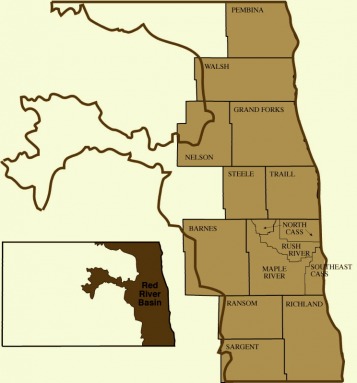
The majority of water resource districts in North Dakota are established along county boundaries. Because water does not respect political boundaries, cooperation is sometimes required among many water resource districts to manage water at the watershed level.
The RRJWRD was the first joint district to be created in North Dakota. It was originally formed in 1979 to address flooding problems in the Red River Valley, when individual board members felt that a joint board was needed to provide a coordinated and cooperative approach to water management in the North Dakota portion of the Red River basin. It was also determined that it would be much easier for one entity to effectively represent the region and to implement a comprehensive water management plan.
There are currently 14 individual water resource districts (see map) that make up the RRJWRD.
The RRJWRD was the first joint district to be created in North Dakota. It was originally formed in 1979 to address flooding problems in the Red River Valley, when individual board members felt that a joint board was needed to provide a coordinated and cooperative approach to water management in the North Dakota portion of the Red River basin. It was also determined that it would be much easier for one entity to effectively represent the region and to implement a comprehensive water management plan.
There are currently 14 individual water resource districts (see map) that make up the RRJWRD.
Benefits Provided by the RRJWRD
Basin-wide Planning:
- RRJWRD members discuss issues, and possible solutions, on a watershed basis
- Discussions with the MN Red River Watershed Management Board (RRWMB)
- Red River Retention Authority (RRRA)
- Comprised of members of RRJWRD, RRWMB, Red River Basin Commission, MN Department of Natural Resources, and ND Department of Water Resources
- The RRRA coordinates and prioritizes flood retention efforts in the basin
- Assist in obtaining federal permits
- Pursue federal funding
- Hydrology models of each tributary watershed have been obtained
- These models are used to determine peak flood reduction on tributaries and mainstem for proposed detention structures
- Hydraulic models on the Red River mainstem are being developed with agreement between the U.S. Army Corps of Engineers and the Red River Basin Commission
- These models could be used to assist member districts in their analysis of water issues
|
USGS Stream Gages:
|
Red River Office:
- ND Department of Water Resource employee located in basin to assist RRJWRD on projects of interest to them
- Also available to work with individual districts on water related issues
LiDAR Tools Development:
- Contracted with the IWI to develop tools using the recent QL2 LiDAR collect
- $95,454 for 11 counties
- Can obtain accurate point elevations, show profile of elevations, watershed delineation tools
- At the suggestion from the NRCS, the RRJWRD contracted with IWI to improve the crop estimates (acreage, type)
- Expect it to improve accuracy in determining benefits of proposed projects
- Could result in more accurate economic analysis, hopefully higher benefit/cost ratio
- Improve chances, and percentage, of cost share from federal and state agencies
- Expect it to improve accuracy in determining benefits of proposed projects
- RRJWRD assists local WRD for hearings required for projects
|
Legislative Sessions:
NDAWN (ND Agricultural Weather Network) Sites:
|
